95% unconsciousness-organized energy field-95% dark energy and matter-95% junk DNA
5% consciousness-observing organized energy field-5% matter-5% DNA A C G T
The new hidden variables interpretation of Ruud Bakker pre-bigbang.com logo
In quantum theory, reality is fundamentally different from classical physics, which assumes an observer-independent reality and continuous variables. Quantum mechanics asserts that physical quantities vary in discrete steps and cannot be observed without influencing the phenomenon. Heisenberg’s uncertainty principle states a minimum uncertainty in simultaneous measurements of quantities like position and momentum.
This principle implies that fundamental processes in nature are probabilistic rather than deterministic, contrasting sharply with classical physics. Quantum mechanics describes particles in terms of probability, with the uncertainty in one quantity increasing if the uncertainty in another decreases.
Albert Einstein objected to this probabilistic nature, proposing hidden variables to restore determinism, but experimental evidence supporting quantum entanglement has largely refuted this.
This new perspective integrates consciousness (observing organized energy fields) and unconsciousness (organized energy fields) with quantum mechanics, relativity, and evolutionary theory.
Author: Ruud Bakker
Quantum mechanics within the framework of the organized energy field
In this section, the complexity of quantum mechanics and its challenges are explored within the framework of the organized energy field. Quantum phenomena like the duality of matter, uncertainty principle, and observer effect are discussed, suggesting that the organized energy field could explain these phenomena. Relativity, gravity, and anti-gravity are also addressed, with a focus on their complementary roles in space and time. The merging of space and time, particle-wave duality, and the organized energy field as a ‘cocoon of matter’ are highlighted as essential for evolution. Phase transitions between dimensions and information processing through waves and interference holograms are discussed within the uncertain domain of quantum mechanics. The role of the observer, both at the quantum and macro levels, is emphasized, suggesting a subjective influence on matter. Overall, the section explores the interplay between quantum mechanics, relativity, and the organized energy field, proposing new insights into the nature of reality.
Read moreBohm….The hidden order in nature through the organized energy field
The chapter explores the concept of the organized energy field across various levels of nature and the universe. It discusses how quantum mechanics has reshaped our understanding of the atomic world, introducing ideas like the uncertainty principle and particle non-locality. Despite advancements, questions remain about the role of the observer and the organized energy field’s function as an information carrier. It suggests that this field encodes fundamental relationships and universal laws, bridging matter and facilitating communication across vast distances. The text also touches on non-locality, hidden variables, and the quantum potential, proposing that the organized energy field serves as a hidden information carrier. It highlights the consistency of these concepts with relativity and their role in maintaining coherence among all matter. Additionally, it addresses the universal values stored within the organized energy field and their significance in shaping the universe’s development. However, the origin of organic consciousness remains elusive within this framework. Despite ongoing exploration, fundamental questions about the universe and consciousness persist.
Read moreFundamental concept of the organized energy field
The concept of the organized energy field is explored in this text, highlighting its role in maintaining stability between matter and antimatter and enabling the evolution of the universe. Despite its significance, traditional scientific frameworks struggle to fully accommodate this concept, leading it to be labeled as mystical or metaphysical. The organized energy field is seen as a fundamental force, influencing the balance between matter and antimatter and facilitating progress and evolution. It is suggested that this field played a crucial role before and during the Big Bang, ensuring a balanced mix of natural forces and constants necessary for the universe’s development. The organized energy field is described as elemental and fundamental, serving as a protective layer between matter and antimatter and enabling information transfer and stabilization. Despite being beyond strict scientific quantification, its presence is undeniable and essential to understanding the universe’s complexities.
Read moreThe true nature of the Higgs / God’s boson
The Higgs boson, discovered in 2012 at CERN’s Large Hadron Collider, is a pivotal component of the Standard Model of particle physics. It plays a crucial role in our understanding of the Big Bang and the origin of mass in the universe.
Shortly after the Big Bang, particles were massless due to the extreme temperature and energy of the universe. However, the Higgs mechanism, involving the Higgs field and its associated boson, allowed particles like quarks and leptons to acquire mass. The Higgs field permeates the universe, imparting resistance to particles as they move through it, effectively creating mass.
As the universe cooled after the Big Bang, the Higgs field underwent a phase transition, leading to the formation of mass for elementary particles. The Higgs boson, with a mass of 125, played a significant role in this process, acting as a refractive index for supersymmetry and influencing the breakdown trajectory of the universe’s supersymmetry.
The Higgs boson’s operational field aligns with that of the electromagnetic force, with fewer particles bound by bosons resulting in stronger binding forces. The weak nuclear force, an outlier, distributes its forces over 12 fermions, including quarks and leptons, and requires W+, W-, and Z bosons with mass.
The ratios 3-6-9 are prominent in the standard model and in time measurement on Earth. After the symmetry break in the organized energy field, these ratios emerge, with the Higgs particle contributing to the distribution of mass and force microscopically and influencing macro-matter distribution, including dark matter and dark energy.
The synchronicity of 3-6-9 extends to the pre-bigbang.com logo and time scales on Earth, demonstrating surprising symmetry ratios with circle circumference and content.
Read more7 steps to understand the universe on a new way
The image presented here illustrates the entangled structure of the Pre-Big Bang era and the unknown structure of a black hole, shedding light on various cosmological mysteries.
Pre-Big Bang Structure:
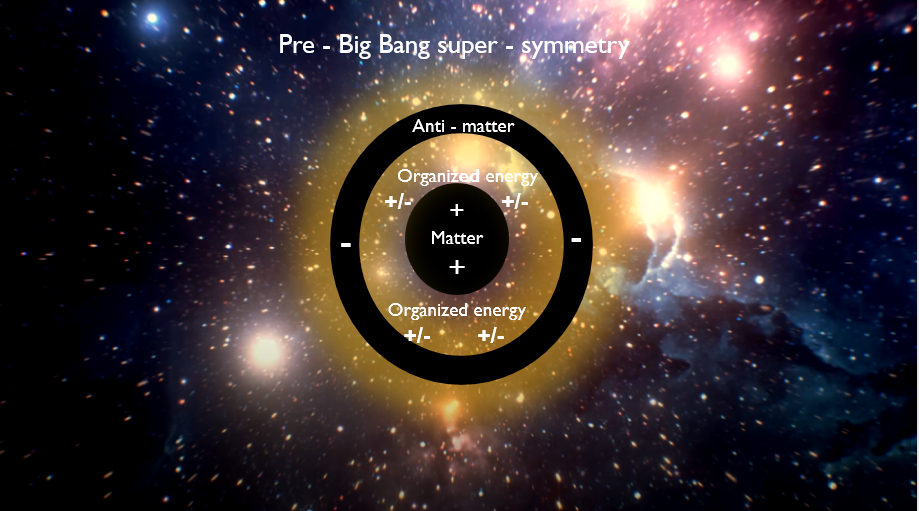
The image depicts a schematic model of the Pre-Big Bang period, where matter and antimatter are safely separated by a protective layer of organized memory energy. This organized memory energy acts as a historical record of the universe’s evolution. Within this structure, space and time dimensions are entangled, and the forms of quarks, leptons, and bosons exist within the circle of organized memory energy. This arrangement resembles a holographic mirror symmetry, reflecting matter and antimatter with a protective shell of memory energy in between.
Black Hole Structure:
Similarly, the image outlines the structure of a black hole, akin to the Pre-Big Bang singularity. Within this model, the holographic mirror symmetry returns to its primal source to renew the organized memory energy. Circles within the black hole depict various components, including matter, dark matter, organized memory energy, dark energy, antimatter, and dark antimatter. These elements are enclosed within separate circles, with dark matter and dark energy residing within the confines of the black hole. The image suggests that dark matter and energy are essential for cosmological models, despite their mysterious nature.
Overall, the image offers insights into the complex interplay of matter, antimatter, memory energy, and cosmological phenomena like black holes, contributing to our understanding of the universe’s evolution and structure.
Read moreWhat caused the Big Bang?
The cause and nature of the Big Bang remain mysterious, but the image suggests a mirror symmetry with separate circles for matter, organized energy, and antimatter preceding it. This organized energy circle acts as protection from the coexistence of matter and antimatter, similar to its role in black holes and dark matter in the universe.
To address inconsistencies in current models, mysteries like dark matter and dark energy are incorporated, as they are essential for explaining observations from telescopes and satellites. Despite the success of the standard model in many areas, it lacks explanations for dark matter and dark energy.
Quantum mechanics and relativity theory, while successful individually, cannot be reconciled without an observer, who plays a crucial role in both theories. The image suggests that the observer is inherently enclosed within the ring of organized energy, serving as a protective layer between matter and antimatter.
Quantum entanglement, a phenomenon at odds with relativity theory, is present in the pre-Big Bang singularity and later in black holes and dark matter. Black holes, often at the center of galaxies, are depicted as gravity cannons and sources of mysterious vacuum energy, related to hidden antimatter from before the Big Bang.
Internally, a black hole is portrayed as a valve with tremendous suction power (dark matter) and organized energy for separation and protection. Externally, it features a circle of dark antimatter with repulsive anti-gravity driving the universe’s expansion.
The image suggests that a new frame of reference is needed to reconcile the strange aspects of quantum mechanics and black holes, unifying them with relativity theory and philosophy. It proposes simplicity as the essence of reality, offering a fresh perspective on these complex phenomena.
Read moreWhy are there laws of nature ?
The description provided outlines a conceptual framework for understanding the emergence of our universe from a state of perfect order, or supersymmetry, before the chaotic event of the Big Bang. According to this framework:
Existence Before the Big Bang: Before the Big Bang, matter and antimatter, natural enemies, coexisted within the same space. They were shielded by a protective layer of organized energy with memory for natural rules and constants.
Role of Anti-Matter: During the Big Bang, antimatter vanished beyond the observational horizon, influencing anti-gravity, the time arrow, and the universe’s expansion. This anti-gravity force is crucial for understanding the increasing expansion of the universe.
Gravity’s Counterforce: Gravity, which lies outside the standard model, counteracts destructive entropy. This force is essential for the emergence of evolution and complexity in the universe.
Mirror Symmetry: Mirror symmetry is observed in quantum entanglement, where entangled particles exhibit opposite and mirrored behavior. This mirrors the symmetry between matter and antimatter in the primal source, separated by organized energy.
Polarity of the Primal Source: The polarity of the primal source, represented by positive and negative charges, serves as a genetic blueprint for the force field within the standard model and the basis of supersymmetry distribution.
Organized Energy: Organized energy, residing between matter and antimatter, signifies the pre-Big Bang evolutionary time path. It leads to the alignment of fundamental laws of nature and serves as a storage space for the universe’s laws and constants.
Forces in Nature: Various forces in nature, such as the strong nuclear force, electromagnetic force, and weak nuclear force, play crucial roles in organizing matter and facilitating the emergence of complexity.
Anti-Gravity: Anti-gravity, originating from antimatter, is the force behind mysterious vacuum energy, increasing space, and driving the forward arrow of time.
This framework suggests a deep interconnection between fundamental forces, matter, and the evolution of the universe, tracing back to a state of perfect order before the Big Bang. It emphasizes the role of organized energy and the intricate balance of opposing forces in shaping the universe’s structure and evolution.
Read moreExtra speed of light in inflation period 4∙10*8 m/s ?
The description provided outlines the depiction of the pre-Big Bang period, where matter and anti-matter, natural opposites, were safely separated by a ring of organized energy. Here’s a summary:
Pre-Big Bang State: Matter and anti-matter, which are antagonistic forces, initially coexisted in the same space before the Big Bang. They were shielded by a protective layer of organized energy that contained the memory of natural rules and constants.
Big Bang Event: During the Big Bang, anti-matter vanished beyond the observational horizon and was propelled away near black holes. The influence of anti-matter led to the emergence of anti-gravity, determined the direction of the time arrow, and fueled the universe’s accelerating expansion.
Role of Gravity: Gravity, a force outside the standard model and notably weak, played a crucial role in counteracting the destructive forces of increasing entropy. Without gravity, the emergence of evolution and complexity would have been impossible.
Stephen Hawking’s Idea: Stephen Hawking proposed the intriguing idea that the Big Bang could be described as an inverted black hole. This perspective adds a unique dimension to our understanding of the universe’s origin, suggesting a connection between the explosive birth of the cosmos and the gravitational collapse observed in black holes.
The passage explores the concept of the pre-Big Bang era, where matter and anti-matter were separated by organized energy. During the Big Bang, anti-matter disappeared, leading to anti-gravity and universe expansion. Gravity, crucial for complexity, counters entropy. Stephen Hawking suggested the Big Bang as an inverted black hole, offering a novel perspective on cosmic origins.
This depiction highlights the interplay between fundamental forces and the dramatic events that shaped the universe’s evolution, leading from a state of perfect order to the chaotic expansion of the cosmos during the Big Bang.
Entanglement – counter clockwise – mirror symmetry !
The passage describes the phenomenon of quantum entanglement and its significance in understanding the fundamental principles shaping our universe. Here’s a summary:
Quantum Entanglement Mystery: Quantum entanglement is described as one of the great mysteries in physics, where there is a simultaneous and mirrored transfer of information between entangled particles. This transfer occurs instantaneously, defying conventional notions of space and time.
Mirror Symmetry: The passage illustrates a mirror symmetry situation with opposite polarization of entangled particles, emphasizing the intricate nature of quantum entanglement. This symmetry is reflected within the primal source, where matter and anti-matter are separated by a protective layer of organized energy.
Primal Source and Polarity: Within the primal source, there is a ground state with a plus and minus orientation, reflecting the mirror symmetry between matter and anti-matter. This polarity serves as a genetic blueprint for the force field within the standard model and the basis of supersymmetry distribution.
Guiding Principles: Positive and negative charges within the primal source serve as guiding principles in the basic rules and laws of the universe, governing attraction and repulsion. The polarity of the primal source permeates all of nature’s laws, influencing the interactions between matter, energy, and anti-matter.
Role of Organized Energy: A ring of organized energy separates matter and anti-matter within the primordial circle, preventing their destructive interaction. This organized energy serves as the storage space for our present universe, housing the laws of nature and constants.
Pre-Big Bang Quantum Entanglement: Quantum entanglement is said to originate from the primal source, existing before the Big Bang. The information density within the primal source is described as infinitely compact and instantaneous, facilitating the communication of laws of nature through quantum entanglement.
Overall, the passage underscores the profound implications of quantum entanglement in understanding the fundamental nature of the universe and highlights its role in preserving and transmitting the laws of nature across cosmic scales.
The passage delves into the enigmatic phenomenon of quantum entanglement, showcasing its mirrored symmetry between entangled particles. It explores how this phenomenon originates within the primal source, where matter and anti-matter are separated by organized energy. This organized energy serves as a storage space for the laws of nature and constants of our universe. Quantum entanglement, existing even before the Big Bang, allows for instantaneous communication of information, highlighting the intricate interplay of matter, energy, and entanglement in shaping our universe.